City of London
Verified local trades for City of London
London Heroes covers City of London around the clock. Every professional is identity-checked by a human, has their credentials verified against evidence and watched for expiry, and every payment is held securely until you confirm the work is done.
Landlord licensing in City of London
Mandatory HMO licensing applies across England. City of London may also operate additional or selective licensing.
- Selective licensing
- Not in operation. No selective licensing scheme was found on any City of London Corporation page fetched. The Corporation's private rented accommodation page tells landlords only that 'properties with five or more tenants belonging to two or more households are required by law to be licensed' - i.e. the national mandatory HMO regime. Again, this is an absence of any mention rather than an explicit denial.
- Additional HMO licensing
- Not in operation. No additional HMO licensing scheme was found anywhere on the City of London Corporation's housing standards or licensing pages. Both the 'Private rented accommodation' page and the 'Houses in multiple occupation HMO' page describe mandatory HMO licensing only, with no mention of any discretionary designation. This is an absence of evidence on the Corporation's own pages rather than an explicit statement that no scheme exists.
The City is a special case and should not be described like a residential borough. The local housing authority is the City of London Corporation, not a London borough council, and its housing pages are oriented mainly around the Corporation's own social housing (the Barbican, Golden Lane and Middlesex Street estates) rather than a large private rented sector. Mandatory HMO licensing does apply, and the Corporation publishes its fee structure openly: an initial fee of £600 on application, plus a fee on grant of licence that varies with the number of lettings - £450 for up to 5 lettings, £600 for 6-9, £750 for 10-14, £900 for 15-19 and £1,050 for 20 or more. It is worth landlords knowing that the HMO licensing page was last updated 16/02/2023 and the private rented accommodation page 21/09/2023, so these pages are not being actively revised; anything time-sensitive should be confirmed with the Environmental Health team on 020 7606 3030.
Checked against the council’s own pages on 21 July 2026. Licensing schemes are five-year designations that expire and get redesignated on their own timetables — always confirm on City of London Council’s licensing pages before applying or paying.
A property somewhere else in London? Check any London address with the free Property Licence Checker — all 33 boroughs on one page, each dated, with the whole dataset free to download.
What City of London is built of — and what that means for repairs
The City is overwhelmingly commercial: its building stock is dominated by offices, from Victorian and Edwardian commercial blocks to post-war and contemporary towers, with a comparatively tiny resident population. What residential stock exists is concentrated in a small number of large post-war estates - most notably the Grade II listed Barbican and Golden Lane estates, plus the Middlesex Street Estate - alongside newer private apartment blocks and a scattering of flats above shops and offices. There is very little of the Victorian terraced housing that defines most London boroughs, and correspondingly little conventional private rented family housing.
Common repair issues in City of London
- Listed-building constraints on the Barbican and Golden Lane estates mean windows, external finishes and even some internal alterations need consent, and materials cannot simply be swapped for modern equivalents
- Concrete-framed post-war blocks bring communal repair issues - roof and podium waterproofing, concrete repair, and long-run services - that are handled at block rather than flat level
- Communal heating, hot water risers and shared plant in the large estates mean individual flat problems often trace back to building-wide systems, and access is controlled by the managing organisation
- Leasehold and service-charge structures dominate, so many works a homeowner would otherwise commission are the freeholder's or managing agent's responsibility
- Asbestos-containing materials are a realistic risk in mid-20th-century blocks and should be assumed present until surveyed before any intrusive work
- Working in a dense, permanently busy commercial district brings practical constraints - restricted delivery and parking, noise-hour limits, and scaffolding or hoarding licences
Areas we cover in City of London
- Barbican
- Golden Lane
- Smithfield
- Blackfriars
- Bank
- Aldgate
- Fleet Street
- Tower Hill
Nearby boroughs
London Heroes covers every neighbouring borough the same way — verified trades, day or night.
Letting out a property in more than one? Check any London address — all 33 boroughs in one place, each dated.

Verified Heroes
Every Hero's identity, insurance and trade credentials are checked before they can take work — and expiry-tracked afterwards.
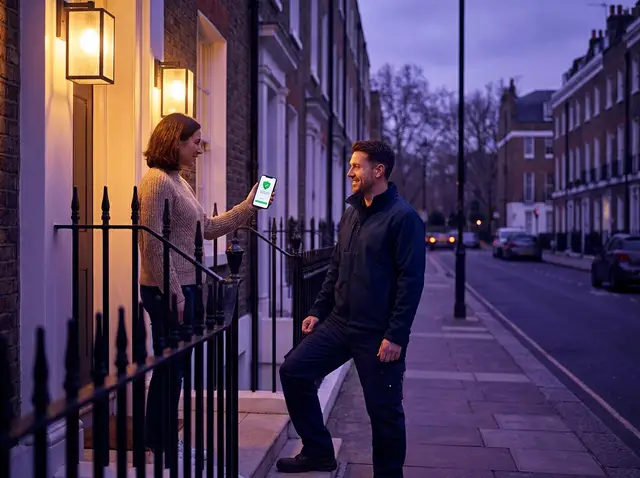
Live Hero Passport
See exactly which checks a Hero has passed, when we last checked, and when each credential expires.

Secure payments
Payments are handled through the platform with a full record of every transaction. No cash-in-hand ambiguity.

Local & accountable
A registered London company with a real complaints process — not an anonymous listings site.
Services in City of London
Ordered for what’s common in City of London’s housing — every service is available to book here, day or night.
Browse all servicesStraight answers for City of London
How do I find a verified plumber or electrician in City of London?
Describe the job at londonheroes.co.uk/request. Every professional on London Heroes has passed a human-reviewed identity check, holds verified credentials (Gas Safe for gas work, competent-person scheme membership for electrical work, public liability insurance) displayed live on their public Hero Passport, and is monitored daily for credential expiry. London Heroes covers City of London around the clock.
How does payment protection work on London Heroes?
You pay when you book, but the money is held securely and only released to the tradesperson when you confirm the work is complete. If something goes wrong before you confirm, raising a dispute freezes the money automatically while a named member of the team investigates — outcomes include partial or full refund. The platform fee is a transparent 10%, paid by the professional.
Are the tradespeople on London Heroes vetted?
Yes — and by a human, not an algorithm. Verification includes photographic ID, a selfie holding the document, business registration for limited companies, and evidence for every declared credential. A lapsed credential shows as expired on the professional's public Passport rather than being hidden, and reviews can only be written by clients of real, paid jobs.
What does it cost to use London Heroes in City of London?
Nothing extra: you pay the professional's quoted price and no booking fees on top. The platform's 10% commission is paid by the professional out of the job price. Cancel before work starts and you receive a full refund.
A trade professional in City of London?
Founding heroes get a live, public verification passport — identity, credentials and verified reviews on one page — plus payment-protected jobs at a straight 10%.